INTRODUCTION
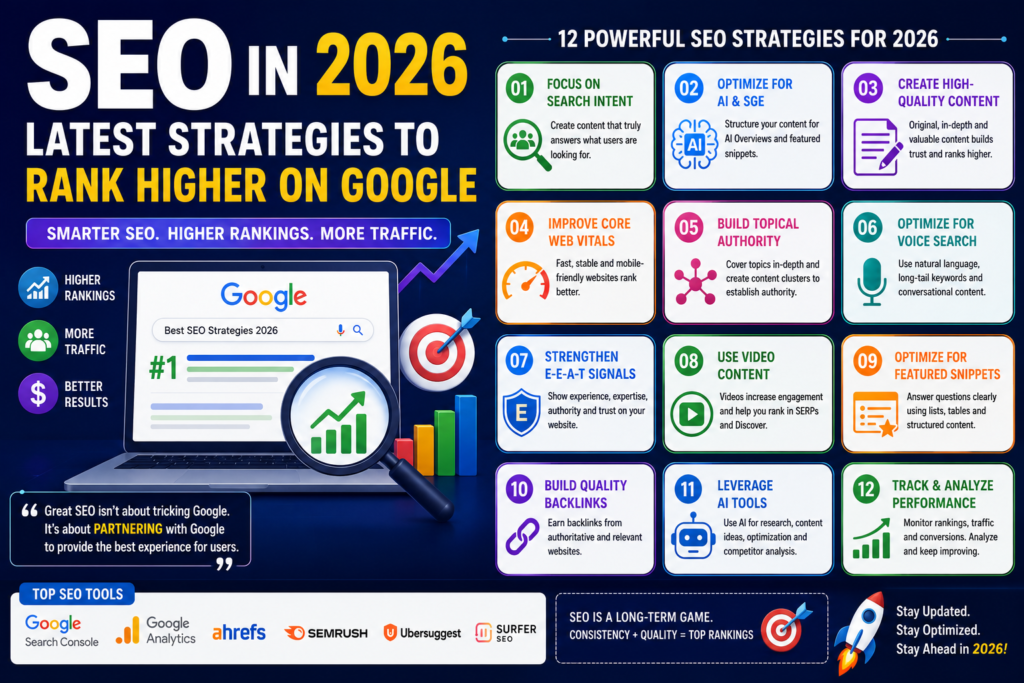
Search Engine Optimization (SEO) continues to evolve at a rapid pace. What worked a few years ago—such as keyword stuffing and mass backlink building—is no longer enough to achieve top rankings on Google. In 2026, Google’s algorithms have become smarter, prioritizing user experience, content quality, authority, and relevance more than ever before.
Whether you’re a business owner, blogger, marketer, or entrepreneur, understanding the latest SEO strategies is essential if you want to stay ahead of the competition and drive organic traffic to your website.
In this guide, we’ll explore the most effective SEO strategies for 2026 and how you can implement them to rank higher on Google.
Why SEO Still Matters in 2026
Despite the rise of AI tools, social media, and paid advertising, SEO remains one of the most cost-effective digital marketing channels.
Benefits of SEO include:
- Long-term traffic growth
- Increased brand visibility
- Higher credibility and trust
- Better user experience
- Improved lead generation
- Higher return on investment
Businesses that invest in SEO continue to enjoy sustainable traffic and reduced customer acquisition costs.
1. Focus on Search Intent, Not Just Keywords
Google’s algorithms are increasingly designed to understand why users search, not just what they type.
There are four primary types of search intent:
- Informational (“What is SEO?”)
- Navigational (“OpenAI website”)
- Commercial (“Best SEO tools”)
- Transactional (“Buy SEO software”)
Before creating content, ask yourself:
- What is the user trying to achieve?
- Does my content answer their question?
- Am I providing more value than competitors?
Content that aligns with search intent is more likely to rank well.
2. Optimize for AI-Powered Search
AI-powered search experiences are becoming increasingly common. Google’s AI-driven search features summarize content and provide users with direct answers.
To optimize for AI search:
- Write concise answers.
- Use headings and subheadings.
- Add FAQ sections.
- Structure content logically.
- Use schema markup.
Websites that provide clear and authoritative information are more likely to be featured in AI-generated results.
3. Prioritize High-Quality Content
Google continues to reward content that demonstrates expertise, experience, authority, and trustworthiness.
Create content that is:
- Original
- Accurate
- Comprehensive
- Easy to read
- Well-structured
Instead of publishing multiple low-quality articles, focus on creating fewer but more valuable pieces of content.
For example, a detailed 1,500-word guide often performs better than several shorter articles covering the same topic.
4. Improve Core Web Vitals
Page experience remains a critical ranking factor.
Pay attention to:
- Page loading speed
- Mobile responsiveness
- Visual stability
- Interactivity
A slow website can negatively impact both rankings and conversions.
Consider:
- Compressing images
- Using a content delivery network (CDN)
- Reducing unnecessary scripts
- Optimizing website code
A faster website creates a better experience for users and search engines alike.
5. Build Topical Authority
Google prefers websites that demonstrate expertise within a specific niche.
Instead of writing about unrelated topics, create clusters of content around your primary area of expertise.
Example for a digital marketing website:
- SEO Guide
- Technical SEO
- Local SEO
- SEO Tools
- SEO Case Studies
- Keyword Research
Publishing interconnected content helps establish topical authority and improves rankings.
6. Optimize for Voice Search
Voice search continues to grow through smartphones and smart assistants.
To optimize for voice search:
- Use conversational language.
- Target long-tail keywords.
- Answer common questions.
- Include FAQs.
Examples:
- “How do I improve SEO in 2026?”
- “What are the latest Google ranking factors?”
Voice searches are often longer and more conversational than traditional text searches.
7. Strengthen Your E-E-A-T Signals
Google values:
- Experience
- Expertise
- Authoritativeness
- Trustworthiness
You can improve your E-E-A-T by:
- Adding author bios.
- Citing reliable sources.
- Displaying testimonials.
- Maintaining updated content.
- Securing your website with HTTPS.
Strong E-E-A-T signals help build trust with both users and search engines.
8. Use Video Content Strategically
Video is becoming an increasingly important part of SEO.
Consider creating:
- Tutorials
- Product demonstrations
- Interviews
- Webinars
- Short-form videos
Embedding videos can improve engagement metrics such as:
- Time on page
- Bounce rate
- User interaction
Search engines often favor pages that keep visitors engaged for longer periods.
9. Optimize for Featured Snippets
Featured snippets appear at the top of Google search results and can significantly increase visibility.
Best practices include:
- Answer questions in 40–60 words.
- Use bullet points.
- Create numbered lists.
- Include tables where appropriate.
For example:
How to Improve SEO in 2026
- Understand search intent.
- Create quality content.
- Improve page speed.
- Build authority.
- Optimize for AI search.
Structured content increases your chances of being selected as a featured snippet.
10. Build High-Quality Backlinks
Backlinks remain one of Google’s most important ranking signals.
Effective backlink strategies include:
- Guest blogging
- Digital PR
- Industry partnerships
- Publishing original research
- Creating shareable resources
Focus on quality over quantity.
One backlink from a highly authoritative website is often more valuable than dozens of low-quality links.
11. Embrace AI Tools for SEO
AI tools can help marketers:
- Generate content ideas
- Conduct keyword research
- Analyze competitors
- Optimize metadata
- Improve productivity
Popular AI tools include:
- ChatGPT
- Surfer SEO
- Perplexity AI
- Ubersuggest
- Gemini
However, AI should support your strategy—not replace human expertise.
12. Monitor Your SEO Performance
SEO is an ongoing process.
Track metrics such as:
- Organic traffic
- Keyword rankings
- Bounce rate
- Conversion rate
- Backlinks
- Click-through rate
Use tools like:
- Google Analytics
- Google Search Console
- Ahrefs
- SEMrush
Regular monitoring helps identify opportunities for improvement.
Common SEO Mistakes to Avoid
Avoid these common mistakes in 2026:
- Keyword stuffing
- Publishing duplicate content
- Ignoring mobile optimization
- Neglecting technical SEO
- Buying low-quality backlinks
- Failing to update old content
Successful SEO requires patience, consistency, and continuous optimization.
CONCLUSION
SEO in 2026 is all about delivering exceptional value to users. Google’s algorithms are smarter than ever, rewarding websites that prioritize quality, trust, and user experience.
If you want to rank higher on Google, focus on understanding your audience, creating authoritative content, improving website performance, and adapting to emerging trends like AI-powered search and voice optimization.
Remember, SEO is not a one-time task—it’s an ongoing investment. Businesses that embrace the latest SEO strategies today will be the ones dominating search results tomorrow.
Start implementing these strategies now, and you’ll be well-positioned to achieve higher rankings, increased traffic, and long-term success in the ever-changing world of digital marketing.