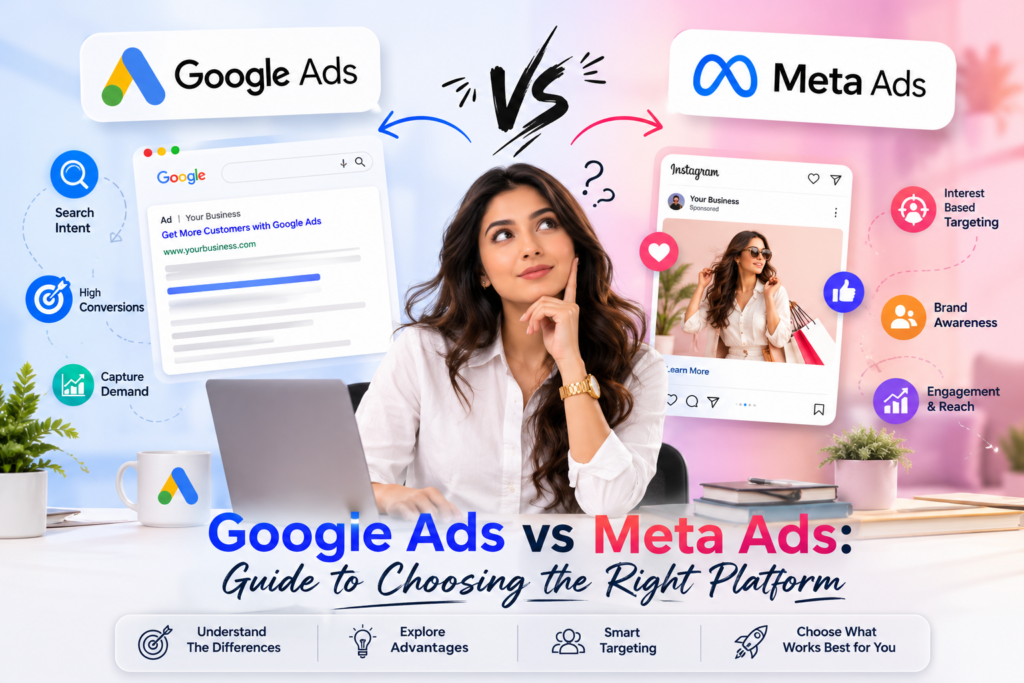
In today’s competitive digital landscape, Google Ads vs Meta have become two of the most powerful online advertising platforms for businesses of every size. Whether you’re a startup, local business, eCommerce store, or established enterprise, choosing the right advertising platform can significantly impact your marketing success.
While both platforms help businesses generate leads, increase website traffic, and boost sales, they work in completely different ways. Google Ads captures people actively searching for products or services, whereas Meta Ads creates demand by showing visually engaging advertisements to users on Facebook, Instagram, Messenger, and Audience Network.
Understanding the strengths of both platforms helps marketers maximize their advertising budget and improve their return on investment (ROI).
What are Google Ads?
Google Ads is Google’s online advertising platform that allows businesses to display advertisements across Google Search, YouTube, Google Display Network, Gmail, Google Shopping, and partner websites.
Google Ads primarily works on intent-based marketing, meaning your advertisements appear when users actively search for keywords related to your business.
For example:
- Best Digital Marketing Course
- Buy Running Shoes Online
- Interior Designer Near Me
- Wedding Cake Bangalore
These users already have buying intent, making Google Ads one of the highest-converting advertising platforms.
Benefits of Google Ads vs Meta
High Purchase Intent
Google users are already looking for products or services, making them more likely to convert.
Instant Visibility
Your website can appear at the top of Google search results immediately after launching campaigns.
Multiple Campaign Types
Google offers several campaign formats:
- Search Ads
- Display Ads
- Shopping Ads
- Performance Max
- Video Ads
- App Campaigns
- Local Campaigns
Advanced Keyword Targeting
Businesses can target users using:
- Exact Match
- Phrase Match
- Broad Match
- Negative Keywords
This improves campaign precision and minimizes wasted spending.
Measurable ROI
Google Ads provides detailed reporting including:
- Click Through Rate (CTR)
- Cost Per Click (CPC)
- Conversion Rate
- Cost Per Acquisition (CPA)
- Return on Ad Spend (ROAS)
What are Google Ads vs Meta?
Meta Ads refer to advertisements shown across Facebook, Instagram, Messenger, and the Meta Audience Network.
Unlike Google Ads, Meta focuses on interest-based advertising.
Users may not actively search for your product, but Meta displays advertisements based on:
- Interests
- Age
- Gender
- Behaviors
- Purchase habits
- Device usage
- Location
- Custom audiences
- Lookalike audiences
This makes Meta Ads highly effective for brand awareness and visual storytelling.
Benefits of Google Ads vs Meta
Powerful Audience Targeting
Meta offers incredibly detailed audience segmentation.
You can target users based on:
- Hobbies
- Shopping behavior
- Education
- Relationship status
- Life events
- Profession
- Interests
Excellent for Brand Awareness
Businesses can reach thousands or even millions of potential customers through engaging creative content.
Lower Advertising Cost
Compared to Google Search campaigns, Meta Ads often have:
- Lower CPC
- Lower CPM
- Higher impressions
This makes them suitable for businesses with limited advertising budgets.
Multiple Creative Formats Google Ads vs Meta
Meta supports:
- Image Ads
- Video Ads
- Carousel Ads
- Collection Ads
- Reels Ads
- Stories Ads
- Lead Generation Ads
Google Ads vs Meta Ads: Key Differences
1. User Intent
Google Ads target users who are actively searching for products or services.
Meta Ads target users based on interests, behaviors, and demographics before they begin searching.
Winner: Google Ads for direct conversions.
2. Targeting
Google targets users using keywords and search intent.
Meta targets users based on audience interests and behavior.
Winner: Meta Ads for audience targeting.
3. Cost
Google Ads generally have a higher CPC due to bidding competition.
Meta Ads often deliver lower CPC and lower CPM, making them cost-effective for awareness campaigns.
Winner: Meta Ads.
4. Conversion Rate
Google Ads generally achieve higher conversion rates because users already intend to purchase.
Meta Ads often require multiple touchpoints before users convert.
Winner: Google Ads.
5. Best Content Format Google Ads vs Meta
Google focuses on:
- Search Ads
- Shopping Ads
- Text Ads
Meta focuses on:
- Videos
- Images
- Reels
- Carousels
- Stories
Winner: Depends on your marketing strategy.
When Should You Use Google Ads vs Meta?
Google Ads work best when your business wants to:
- Generate qualified leads
- Increase online sales
- Capture search demand
- Promote local services
- Drive website traffic
- Generate phone calls
- Target customers with high buying intent
Industries that benefit most include:
- Real Estate
- Healthcare
- Legal Services
- Education
- Digital Marketing Agencies
- Interior Designers
- Home Services
- Finance
When Should You Use Google Ads and Meta ?
Meta Ads perform exceptionally well for businesses looking to:
- Build brand awareness
- Increase followers
- Promote lifestyle products
- Showcase visual products
- Generate engagement
- Grow communities
- Retarget website visitors
Industries that benefit include:
- Fashion
- Beauty
- Jewelry
- Food
- Fitness
- Travel
- Home Decor
- Wedding Services
- Cake Businesses
- Restaurants
Can You Use Google Ads and Meta Together
Absolutely.
Successful digital marketing strategies often combine both platforms.
For example:
Step 1: Run Meta Ads to introduce your brand to new audiences through engaging videos and visuals.
Step 2: As potential customers become interested, many will search for your business on Google.
Step 3: Google Search Ads capture these high-intent users and convert them into customers.
Step 4: Use remarketing campaigns on both platforms to re-engage visitors who didn’t convert initially.
This full-funnel strategy improves visibility, trust, and conversions while maximizing ROI.
Tips to Maximize ROI from Google and Meta Ads
- Define clear campaign objectives before launching ads.
- Conduct thorough keyword research for Google Ads.
- Create compelling visuals and videos for Meta Ads.
- Use audience segmentation and custom audiences.
- Install tracking pixels and conversion tags.
- A/B test headlines, creatives, and calls to action.
- Monitor performance metrics regularly.
- Optimize campaigns based on real-time data.
- Allocate budget based on campaign performance.
- Continuously refine targeting to reduce wasted spend.
Common Mistakes to Avoid Google Ads vs Meta
Many advertisers fail to achieve results because they:
- Target overly broad audiences.
- Ignore keyword research.
- Use weak ad copy or low-quality creatives.
- Fail to track conversions accurately.
- Neglect landing page optimization.
- Don’t test multiple ad variations.
- Stop campaigns before collecting enough data.
- Ignore mobile user experience.
Avoiding these mistakes can significantly improve campaign performance and advertising efficiency.
Final Thoughts Google Ads vs Meta
There is no universal winner in the Google Ads vs Meta Ads debate. The ideal platform depends on your business goals, target audience, budget, and marketing strategy.
If your priority is capturing customers who are actively searching for your products or services, Google Ads is the better choice due to its high purchase intent and strong conversion potential.
If your goal is to increase brand awareness, engage audiences with creative content, and reach highly specific customer segments, Meta Ads offers exceptional targeting capabilities and cost-effective reach.
For businesses seeking sustainable growth, the most effective approach is often to combine both platforms. By using Google Ads to capture demand and Meta Ads to generate demand, you create a comprehensive digital marketing strategy that supports every stage of the customer journey—from discovery to conversion and beyond.
SEO Optimization Google Ads vs Meta
Primary Keyword:
- Google Ads vs Meta Ads
Secondary Keywords:
- Google Ads
- Meta Ads
- Facebook Ads
- Instagram Ads
- Digital Advertising
- PPC Advertising
- Online Advertising
- Search Engine Marketing
- Social Media Advertising
- Google Search Ads
- Performance Marketing
- Paid Advertising
- Advertising ROI
- Google Advertising
- Meta Advertising
Keyword Clusters:
- Google Ads campaign
- Meta Ads campaign
- Facebook advertising strategy
- Instagram advertising tips
- Google PPC advertising
- Digital marketing strategy
- Paid search advertising
- Social media marketing
- Lead generation ads
- Conversion optimization
- Online marketing ROI
- Google Search campaigns
- Audience targeting
- Remarketing campaigns
- Performance marketing strategy