INTRODUCTION
Artificial Intelligence (AI) has become one of the biggest disruptors in the digital marketing world. From generating blog posts and social media captions to analyzing customer behavior and automating campaigns, AI is changing how businesses create and distribute content.
At the same time, content marketing remains one of the most effective strategies for building trust, attracting audiences, and driving long-term growth.
This raises an important question: Is AI replacing content marketing, or is it simply transforming it?
The answer isn’t as simple as choosing one over the other. In 2026, the relationship between AI and content marketing is more collaborative than competitive. Businesses that understand how to combine both are gaining a significant advantage.
In this article, we’ll explore the differences between AI and content marketing, their strengths and limitations, and what the future holds for marketers.
What Is AI in Digital Marketing?
Artificial Intelligence refers to technologies that can perform tasks typically requiring human intelligence.
In digital marketing, AI is used for:
- Content generation
- Customer support
- Data analysis
- Predictive analytics
- Email automation
- SEO optimization
- Ad targeting
- Social media management
Popular AI tools include:
- ChatGPT
- Gemini
- Canva AI
- Perplexity AI
- Grammarly
- Surfer SEO
These tools are helping marketers work faster and more efficiently than ever before.
What Is Content Marketing?
Content marketing is the process of creating and sharing valuable content to attract, engage, and retain an audience.
Examples include:
- Blog posts
- Videos
- Podcasts
- Newsletters
- Social media posts
- E-books
- Case studies
The primary goal of content marketing is to build trust and establish authority over time.
Unlike paid advertising, content marketing focuses on delivering value before asking for a sale.
AI vs Content Marketing: Understanding the Difference
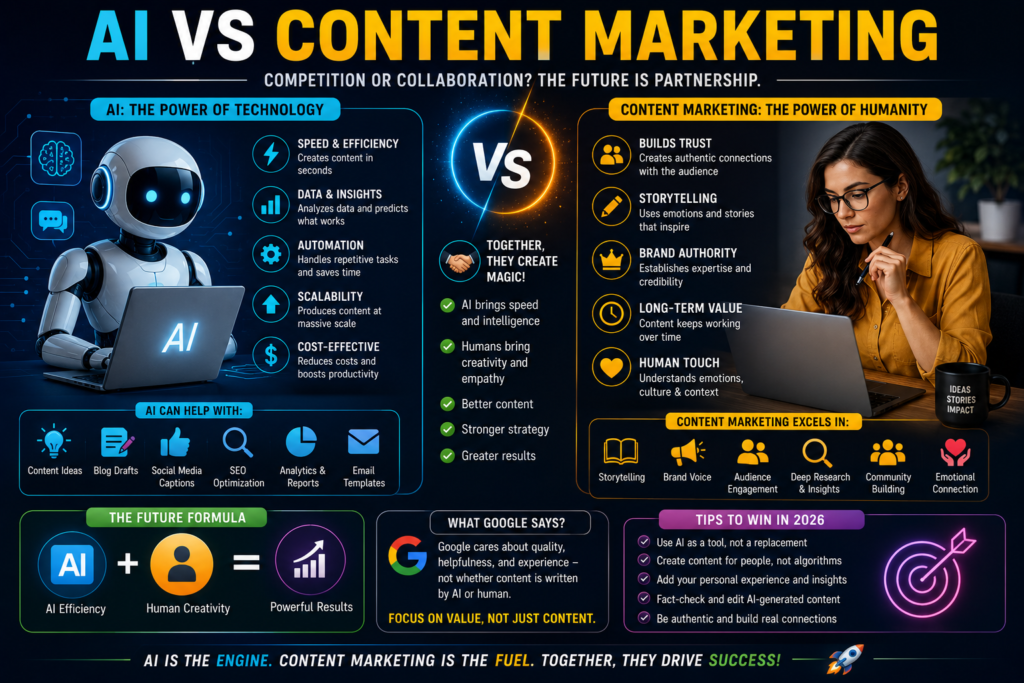
| AI | Content Marketing |
|---|---|
| Technology-driven | Strategy-driven |
| Focuses on automation | Focuses on audience engagement |
| Produces content quickly | Builds relationships over time |
| Uses data and algorithms | Uses storytelling and creativity |
| Improves efficiency | Improves brand trust |
AI is a tool, while content marketing is a strategy.
Businesses often make the mistake of viewing them as competitors when, in reality, they work best together.
The Strengths of AI
1. Speed
AI can generate:
- Blog outlines
- Captions
- Product descriptions
- Email drafts
Tasks that once took hours can now be completed in minutes.
2. Scalability
AI allows businesses to create content at scale.
For example:
- 100 social media captions
- Multiple email variations
- SEO recommendations
- Content calendars
3. Data Analysis
AI excels at processing large amounts of information.
It can help marketers:
- Identify trends
- Analyze competitors
- Predict customer behavior
- Optimize campaigns
4. Cost Efficiency
Small businesses can leverage AI to reduce costs while maintaining productivity.
The Strengths of Content Marketing
1. Builds Trust
People connect with stories, experiences, and emotions.
Content marketing helps businesses establish:
- Credibility
- Authority
- Loyalty
2. Supports SEO
High-quality content remains one of Google’s most important ranking factors.
Well-optimized blogs can drive organic traffic for years.
3. Creates Emotional Connections
AI can generate text, but humans understand emotions, experiences, and cultural context more deeply.
Examples include:
- Personal stories
- Brand narratives
- Customer testimonials
4. Long-Term Value
A valuable blog post published today can continue generating leads and traffic for months or even years.
Can AI Replace Content Marketers?
This is one of the most debated questions in the industry.
The short answer is: No.
AI can:
- Assist with research.
- Generate first drafts.
- Improve productivity.
However, AI cannot fully replace:
- Human creativity
- Strategic thinking
- Emotional intelligence
- Authentic storytelling
- Brand voice
Consumers increasingly value authenticity, making human input more important than ever.
What Google Thinks About AI Content
Google has made it clear that it prioritizes helpful, high-quality content regardless of how it is created.
Google rewards content that demonstrates:
- Experience
- Expertise
- Authoritativeness
- Trustworthiness
This means AI-generated content can perform well if it:
- Provides value
- Is fact-checked
- Meets user intent
- Includes human oversight
Publishing low-quality AI content solely for rankings is unlikely to succeed.
The Best Approach: AI + Human Creativity
The future of marketing belongs to businesses that combine AI with human expertise.
AI Handles:
- Research
- Brainstorming
- Editing
- Automation
- Data analysis
Humans Handle:
- Strategy
- Storytelling
- Brand positioning
- Emotional connection
- Final quality checks
Together, they create a powerful marketing ecosystem.
Real-World Example
Imagine a digital marketing agency.
Without AI:
- Blog creation: 5 hours
- Social media planning: 3 hours
- Email writing: 2 hours
With AI:
- Blog draft: 20 minutes
- Social media ideas: 10 minutes
- Email drafts: 5 minutes
The team can now spend more time on strategy, creativity, and client relationships.
Emerging Trends in 2026
AI Search Optimization
Marketers are increasingly optimizing content for AI-powered search experiences.
Hyper-Personalization
AI enables personalized experiences based on customer behavior and preferences.
Video Content
Short-form video continues to dominate content consumption.
Voice Search
Voice assistants are influencing how people search and consume information.
Community Building
Brands are focusing more on building communities rather than simply increasing follower counts.
Common Mistakes to Avoid
AI Mistakes
- Publishing unedited AI content
- Ignoring fact-checking
- Over-automating communication
Content Marketing Mistakes
- Posting inconsistently
- Ignoring SEO
- Failing to understand audience needs
Successful marketers avoid relying entirely on either approach.
Who Wins: AI or Content Marketing?
The truth is, there isn’t a winner.
AI and content marketing serve different purposes:
- AI increases efficiency.
- Content marketing builds relationships.
Businesses that embrace both will outperform those that rely exclusively on one.
CONCLUSION
AI isn’t here to replace content marketing—it’s here to enhance it.
In 2026, successful marketers understand that technology and creativity are not opposing forces. AI can save time, improve productivity, and uncover valuable insights, while content marketing continues to build trust, authority, and meaningful connections.
The future belongs to marketers who know how to leverage AI without losing the human touch.
Remember: AI may write the words, but humans create the stories that people remember.
Rather than asking whether AI will replace content marketing, ask yourself this:
How can I use AI to become a better content marketer?
The answer to that question may define the future of y