INTRODUCTION
In today’s hyper-connected world, digital marketing has become an essential part of doing business. Gone are the days when small businesses could rely solely on word-of-mouth, newspaper advertisements, or storefront visibility to attract customers.
In 2026, consumers spend a significant portion of their time online—searching for products, reading reviews, watching videos, and engaging with brands on social media. If your business isn’t visible online, you’re likely missing out on valuable opportunities.
Digital marketing is no longer a luxury reserved for large corporations with massive budgets. It has become one of the most affordable and effective ways for small businesses to compete, grow, and succeed.
In this article, we’ll explore why small businesses need digital marketing more than ever before and how it can help them thrive in an increasingly competitive marketplace.
What Is Digital Marketing?
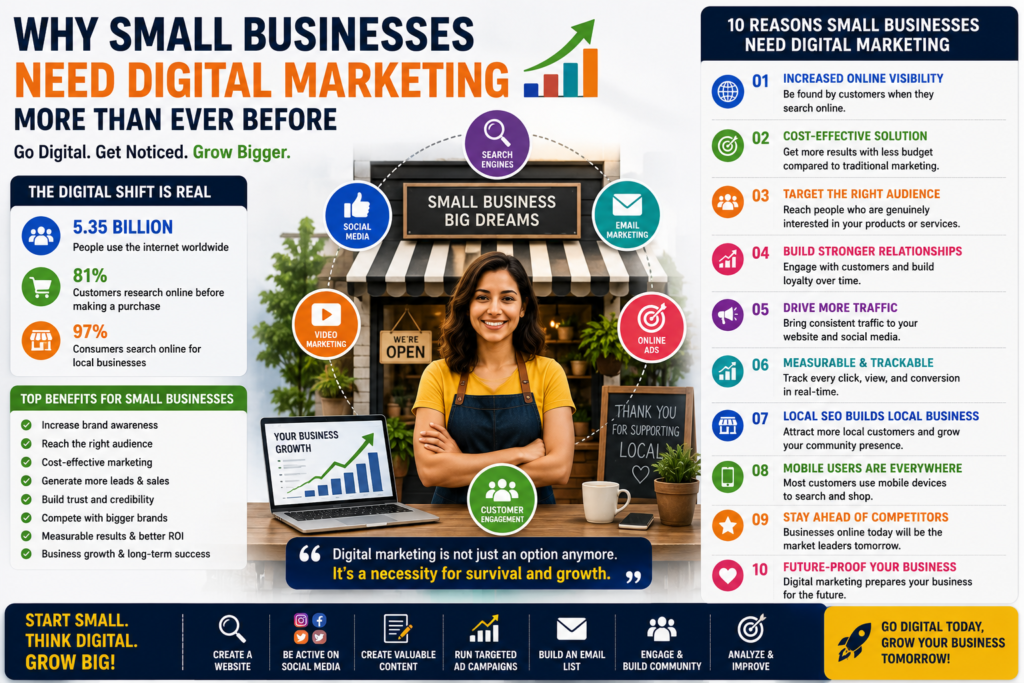
Digital marketing refers to promoting products or services through online channels such as:
- Search engines (Google)
- Social media platforms
- Email marketing
- Websites and blogs
- Video marketing
- Online advertisements
- Influencer marketing
Unlike traditional marketing, digital marketing allows businesses to reach the right audience at the right time while tracking performance in real time.
The Changing Consumer Behavior
Consumer behavior has changed dramatically over the past decade.
Today’s customers:
- Search online before making purchases.
- Read reviews and ratings.
- Compare competitors.
- Follow brands on social media.
- Prefer personalized experiences.
Imagine owning a bakery in Bangalore. A potential customer searching “best birthday cakes near me” is likely to choose one of the businesses appearing on the first page of Google.
If your business doesn’t have an online presence, you’re invisible to a large segment of your target audience.
1. Increased Online Competition
Every day, thousands of new businesses launch online.
Whether you run:
- A clothing store
- A café
- A salon
- A home bakery
- A consulting business
Your competitors are likely investing in digital marketing.
Without it, staying competitive becomes increasingly difficult.
Digital marketing helps small businesses:
- Increase visibility
- Build brand awareness
- Reach new customers
- Stay ahead of competitors
2. Cost-Effective Marketing
Traditional advertising methods can be expensive.
Examples include:
- Television ads
- Billboards
- Newspaper advertisements
- Radio campaigns
Digital marketing, on the other hand, offers affordable alternatives.
For example:
- Running Instagram ads with a small daily budget
- Publishing SEO blogs
- Sending email newsletters
- Creating organic social media content
Small businesses can achieve significant results without spending large amounts of money.
3. Better Targeting
One of the biggest advantages of digital marketing is precise audience targeting.
You can target customers based on:
- Age
- Gender
- Location
- Interests
- Behavior
- Purchase history
For example, a wedding photographer can target engaged couples within a specific city rather than advertising to everyone.
This improves efficiency and increases return on investment.
4. Improved Brand Awareness
Customers are more likely to purchase from brands they recognize and trust.
Digital marketing helps businesses establish:
- Credibility
- Authority
- Recognition
Strategies include:
- Posting consistently on social media
- Creating educational content
- Engaging with customers
- Collecting testimonials
Over time, these efforts contribute to stronger brand awareness.
5. Higher Customer Engagement
Digital marketing enables businesses to communicate directly with customers.
Popular engagement channels include:
Businesses can:
- Answer questions
- Respond to comments
- Conduct polls
- Share updates
- Build communities
Engaged customers are more likely to become loyal customers.
6. Measurable Results
Traditional marketing often makes it difficult to determine what works.
Digital marketing provides real-time data such as:
- Website traffic
- Conversion rates
- Click-through rates
- Social media engagement
- Email open rates
These insights help businesses optimize their strategies and make informed decisions.
7. Local SEO Drives Customers
Local SEO has become increasingly important.
When customers search for:
- “Restaurants near me”
- “Best salon in Bangalore”
- “Home bakery nearby”
Businesses optimized for local search are more likely to appear.
Essential local SEO strategies include:
- Creating a Google Business Profile
- Collecting reviews
- Optimizing location-based keywords
- Maintaining consistent business information
For small businesses, local SEO can be a game changer.
8. Supports Business Growth
Digital marketing doesn’t just attract customers—it supports long-term growth.
Benefits include:
- Increased revenue
- Better customer retention
- Greater scalability
- Expanded market reach
A local business can eventually serve customers nationwide—or even globally—with the right digital strategy.
9. AI Is Changing Marketing
Artificial Intelligence is transforming how businesses market themselves.
AI tools can help with:
- Content creation
- Graphic design
- Customer support
- Email automation
- Data analysis
Small businesses can now access tools that were once only available to large corporations.
Popular AI tools include:
- ChatGPT
- Canva AI
- Grammarly
- Gemini
- Perplexity AI
Leveraging AI can improve productivity and reduce costs.
10. Builds Trust Through Content
Content marketing is one of the most effective ways to build trust.
Examples include:
- Blog posts
- Videos
- Tutorials
- FAQs
- Case studies
Providing valuable content demonstrates expertise and helps customers make informed decisions.
People buy from businesses they trust.
Common Mistakes Small Businesses Make
Many small businesses:
- Ignore social media
- Neglect SEO
- Fail to maintain websites
- Avoid collecting reviews
- Post inconsistently
Avoiding these mistakes can significantly improve online visibility and performance.
A Simple Digital Marketing Strategy for Small Businesses
Step 1
Create:
- A website
- Google Business Profile
- Social media accounts
Step 2
Publish:
- Three social media posts weekly
- One blog monthly
- Regular email newsletters
Step 3
Invest in:
- Google Ads
- Instagram Ads
- SEO optimization
Step 4
Track:
- Traffic
- Leads
- Sales
- Engagement
Consistency is key to achieving results.
CONCLUSION
Digital marketing is no longer optional for small businesses in 2026—it’s essential.
Consumers expect businesses to have an online presence, provide valuable content, and engage with them across digital channels. Small businesses that embrace digital marketing are better positioned to attract customers, compete effectively, and achieve sustainable growth.
Whether you’re running a bakery, salon, consultancy, or online store, digital marketing can help you reach more people, build stronger relationships, and increase revenue.
The businesses that succeed tomorrow will be the ones investing in their digital presence today.
If you’re a small business owner wondering whether digital marketing is worth it, the answer is simple: there’s never been a better time to start.