INTRODUCTION
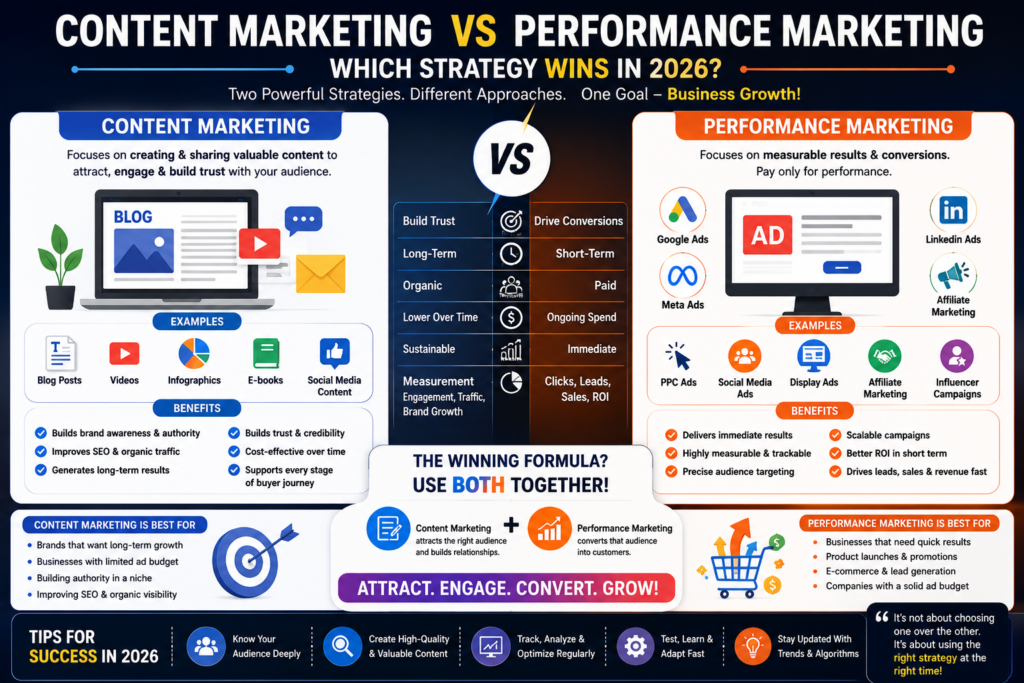
Digital marketing is constantly evolving, and businesses today have more options than ever when it comes to reaching their audiences. Two of the most popular approaches are Content Marketing and Performance Marketing. While both strategies aim to drive business growth, they operate in fundamentally different ways.
One focuses on building long-term trust and authority, while the other prioritizes immediate results and measurable returns.
So, which one should you choose in 2026?
The answer depends on your goals, budget, timeline, and target audience. In this guide, we’ll break down the differences between content marketing and performance marketing, explore their benefits and drawbacks, and help you determine which strategy is best for your business.
What Is Content Marketing?
Content marketing is the practice of creating and distributing valuable, relevant, and consistent content to attract and retain an audience.
Examples include:
- Blog posts
- Videos
- Podcasts
- Infographics
- E-books
- Social media content
- Newsletters
The primary objective of content marketing is to educate, inform, and build trust with potential customers over time.
Benefits of Content Marketing
- Builds brand authority
- Improves SEO rankings
- Generates long-term traffic
- Increases customer trust
- Supports all stages of the buyer journey
- Provides sustainable results
Example
A digital marketing agency publishing weekly SEO blogs may attract thousands of organic visitors every month without paying for ads.
What Is Performance Marketing?
Performance marketing focuses on achieving specific, measurable outcomes such as:
- Clicks
- Leads
- Sales
- Downloads
- Conversions
Advertisers pay based on results, making this approach highly data-driven.
Popular performance marketing channels include:
- Google Ads
- Meta Ads
- LinkedIn Ads
- Affiliate marketing
- Influencer campaigns
- Programmatic advertising
Benefits of Performance Marketing
- Immediate results
- Highly measurable
- Scalable campaigns
- Precise targeting
- Faster lead generation
Example
An e-commerce brand running Google Ads can generate sales within hours of launching a campaign.
Content Marketing vs Performance Marketing
| Factor | Content Marketing | Performance Marketing |
|---|---|---|
| Goal | Build trust | Generate conversions |
| Timeline | Long-term | Short-term |
| Cost | Lower over time | Ongoing ad spend |
| ROI | Sustainable | Immediate |
| Traffic | Organic | Paid |
| Measurement | Engagement, traffic | Clicks, leads, sales |
| Scalability | Gradual | Fast |
Both strategies are effective, but they serve different purposes.
When Should You Choose Content Marketing?
Content marketing is ideal if you:
- Want long-term growth.
- Have a limited advertising budget.
- Want to improve SEO.
- Need to establish authority.
- Are building a personal brand.
Best Industries
- Education
- Consulting
- SaaS
- Blogging
- Healthcare
- Real Estate
Content marketing is particularly valuable for businesses that rely on trust and expertise.
When Should You Choose Performance Marketing?
Performance marketing is best if you:
- Need quick results.
- Want immediate leads or sales.
- Have an advertising budget.
- Are launching a new product.
- Need measurable outcomes.
Best Industries
- E-commerce
- Events
- Retail
- Mobile apps
- Subscription businesses
Performance marketing is ideal for businesses looking to scale quickly.
Which Offers Better ROI?
This is one of the most frequently asked questions.
Content Marketing ROI
Content marketing often provides:
- Long-lasting traffic
- Reduced acquisition costs
- Increased brand awareness
- Better SEO performance
A blog published today could continue generating traffic for years.
Performance Marketing ROI
Performance marketing offers:
- Faster revenue generation
- Precise targeting
- Immediate campaign insights
- Predictable results
However, once you stop spending on ads, traffic typically stops as well.
Why Smart Businesses Use Both
The truth is, the most successful companies don’t choose one over the other—they combine both.
A modern marketing strategy might look like this:
Content Marketing
- Publish SEO blogs.
- Create YouTube videos.
- Build an email list.
- Share educational content.
Performance Marketing
- Promote top-performing content.
- Run retargeting campaigns.
- Generate leads through paid ads.
- Scale successful campaigns.
This hybrid approach delivers both short-term and long-term benefits.
The 2026 Marketing Funnel
Awareness Stage
Use:
- Blog posts
- Social media content
- Videos
Consideration Stage
Use:
- Case studies
- Webinars
- Email marketing
Conversion Stage
Use:
- Google Ads
- Meta Ads
- Landing pages
Retention Stage
Use:
- Newsletters
- Loyalty campaigns
- Community engagement
Combining content and performance marketing allows businesses to support customers throughout the entire journey.
Emerging Trends in 2026
AI-Powered Content Creation
Tools like ChatGPT and Canva AI are helping marketers create content faster than ever.
Hyper-Personalization
Customers expect personalized experiences across all channels.
Short-Form Video
Reels, Shorts, and TikTok continue to dominate attention.
First-Party Data
Businesses are relying more on their own customer data due to increasing privacy regulations.
Marketing Automation
Automation tools are streamlining workflows and improving campaign efficiency.
Both content and performance marketers are leveraging these trends to remain competitive.
Common Mistakes to Avoid
Content Marketing Mistakes
- Publishing inconsistent content
- Ignoring SEO
- Creating low-value articles
- Failing to measure results
Performance Marketing Mistakes
- Poor audience targeting
- Weak ad creatives
- Ignoring landing page optimization
- Overspending without testing
Avoiding these mistakes can significantly improve campaign performance.
Final Verdict
So, which strategy should you choose?
Choose Content Marketing If:
- You want sustainable growth.
- You aim to build authority.
- You have time to invest.
- You prioritize SEO.
Choose Performance Marketing If:
- You need immediate results.
- You have a dedicated ad budget.
- You want measurable outcomes.
- You are launching a product or service.
Choose Both If:
- You want the best of both worlds.
In 2026, businesses that integrate content marketing and performance marketing are likely to outperform those relying on a single strategy.
CONCLUSION
Content marketing and performance marketing aren’t competitors—they’re complementary tools in a successful digital marketing strategy.
Content marketing builds trust, authority, and long-term value. Performance marketing delivers speed, scalability, and measurable results.
Rather than asking which one is better, consider how you can combine both to achieve your business goals.
The future of marketing belongs to businesses that educate, engage, and convert. By leveraging both content and performance marketing, you’ll be better equipped to thrive in the competitive digital landscape of 2026.
Remember: Content attracts. Performance converts. Together, they creat